
Take Care of Yourself.
How your body today shapes your family’s future — and what to do about it.
Picture two women. Both are 75. Both have daughters who love them deeply.
The first woman’s daughter gets a call on a Tuesday morning — her mother has fallen again. She leaves work early, rearranges her week, and spends the afternoon in the emergency room. At night, she lies awake wondering how much longer she can manage the driving, the appointments, the medications, the worry. She loves her mother completely. But she is exhausted, stretched thin between her job, her own children, and a parent who needs more than she can give.
The second woman’s daughter visits on a Saturday. They walk together in the park. They have lunch. The daughter drives home feeling light, grateful, full.
Same love. Very different lives.
What made the difference? The choices the second woman made in her 60s.
The Sandwich Generation: A Silent Crisis
There is a term for what millions of adults are quietly living through: the “sandwich generation.” These are people — often in their 40s and 50s — who are simultaneously raising their own children and caring for aging parents. They are squeezed between two generations of need, with their own health, finances, and wellbeing quietly eroding in the middle.
You may not have heard the term, but you almost certainly know someone living it. The son who moved his mother into his spare room. The woman who takes every Friday off to drive her father to dialysis. The couple who postponed their retirement because they are paying for two households.
It is not a failure of love. It is often the opposite. But it is also, in many cases, preventable.
What Decline Actually Looks Like — and Why It’s Not Inevitable
Here is what most people do not know: the kind of decline that leads to dependency is largely not inevitable. It is not simply “getting old.” It is the consequence of years of inactivity, disconnection, and neglect of the body.
From our 50s onward, we naturally begin to lose muscle mass — a process called sarcopenia. Without deliberate effort to counter it, we become progressively weaker, less stable, less able to recover from setbacks. Falls become more likely. Recovery from illness takes longer. Simple daily tasks that require balance, strength, and flexibility begin to feel difficult.
Falls, in particular, are a leading trigger of elder dependency. A single fall can mean a broken hip, a hospitalisation, and a rapid decline in independence that changes everything — for the person who fell, and for their family.
But here’s the truth that deserves to be said more loudly: this trajectory is not fixed. The body responds to movement at every age. Strength can be built in your 60s, 70s, and beyond. Balance can be trained. Mobility can be maintained and even restored. The window is not closed. It is wide open — but it requires intention.
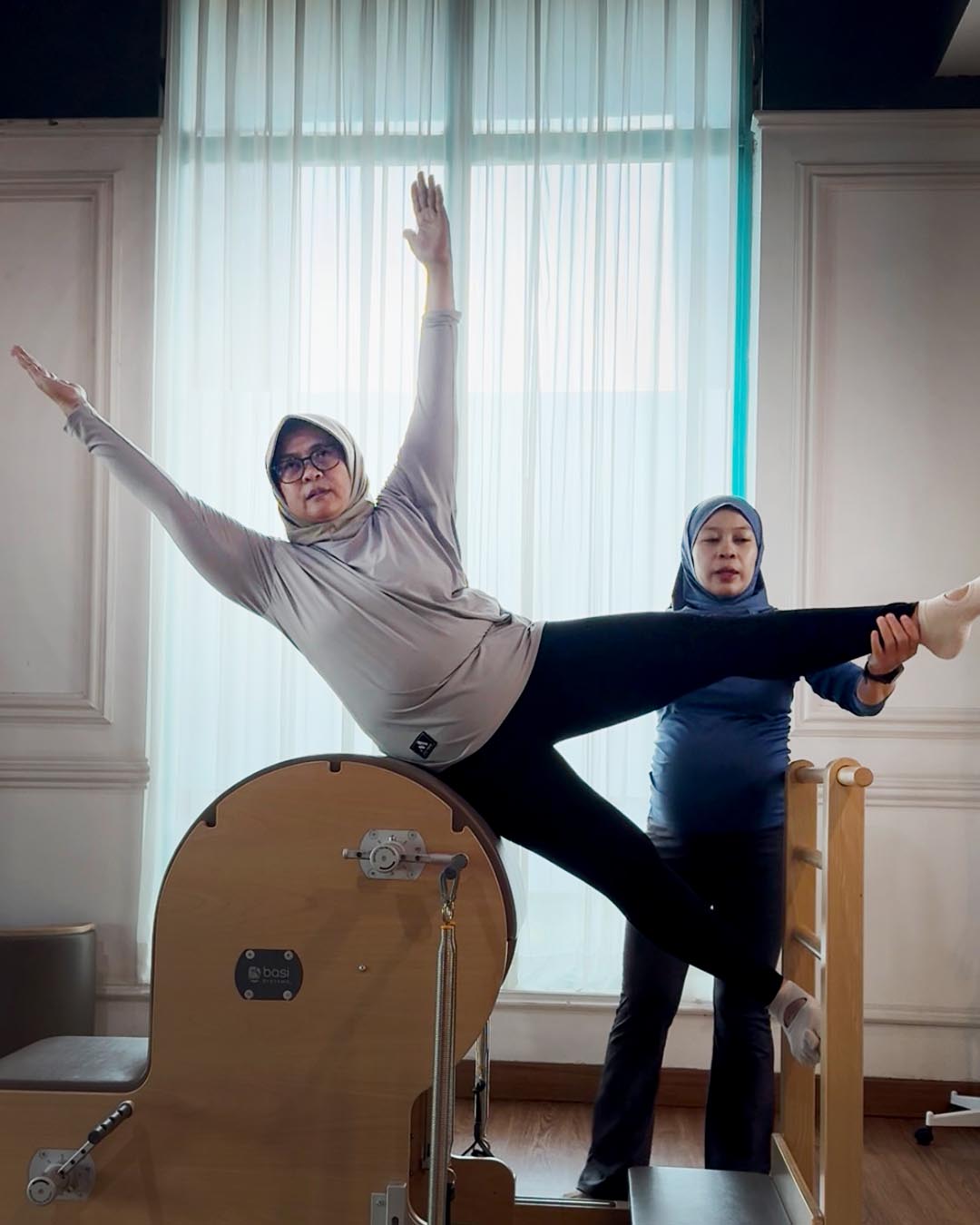
As a Pilates teacher, I work with women and men in their 60s every week. I see the difference — not just in how they move, but in how they carry themselves through life. The ones who commit to their bodies in this decade do not just feel better. They stay independent longer. They need less. They give more.
Reframing the Work
For many people, exercise lives in the category of “things I should do for myself.” It sits alongside eating better and sleeping more: worthy, a bit guilty, easy to postpone.
I want to offer a different frame entirely.
Taking care of your body in your 60s is an act of love for your children.
Every time you show up to move your body, you are making a quiet investment in your family’s future. You are reducing the likelihood that your daughter will one day have to choose between her career and your care. You are protecting your son from the financial and emotional weight of managing your decline. You are giving your grandchildren a grandmother who can get on the floor with them, who shows up fully, who is present rather than managed.
This is not about vanity. It is not about being impressive or defying age. It is about the simple, powerful act of not becoming a burden — not because being cared for is shameful, but because the people who love you deserve to love you freely, without being crushed under the weight of obligation.
When you think of it this way, showing up to class is no longer something you do for yourself. It becomes something you do for them.
Community as Medicine
The body matters. But there is something else that matters just as much, and that gets far less attention: connection.
One of the most significant risk factors for decline in later life is not physical — it is social isolation. Loneliness accelerates cognitive decline. It weakens the immune system. It erodes the will to keep trying. Conversely, people who remain embedded in community — who have people who notice when they’re absent, who laugh with them, who check in — are measurably healthier and more resilient.
This is one of the underrated gifts of a regular group class. It is not just exercise. It is a network of people who know your name, notice your progress, and celebrate your presence. It is a reason to get dressed and get out of the house. It is structure in a phase of life where structure can quietly disappear.
A strong community does something else, too: it reduces the pressure on family. When you have people around you — friends, neighbours, a class you belong to — your children are not the only net beneath you. You have built something wider. You are not dependent on one thread.
The Question Worth Asking
I often ask the people I work with a simple question: What kind of elder do you want to be?
Not “what kind of body do you want?” Not “how do you want to look?” But: who do you want to be in your family’s life at 75, 80, 85? What role do you want to play? What kind of presence do you want to be?
Most people, when they sit with that question, have a clear answer. They want to be independent. They want to be active. They want to be a source of joy in their family, not a source of worry. They want to be visited out of love, not obligation.
That version of yourself is not a fantasy. But it does not happen by accident. It is built — one session at a time, one choice at a time, starting now.
Your 60s are not the beginning of the end. They are the most important decade of investment you will ever make — in your health, your independence, and your family’s future.
Show up for yourself. It is the most generous thing you can do for the people you love.
